9 November 2026
How to calculate boom deflection angle for river current speed
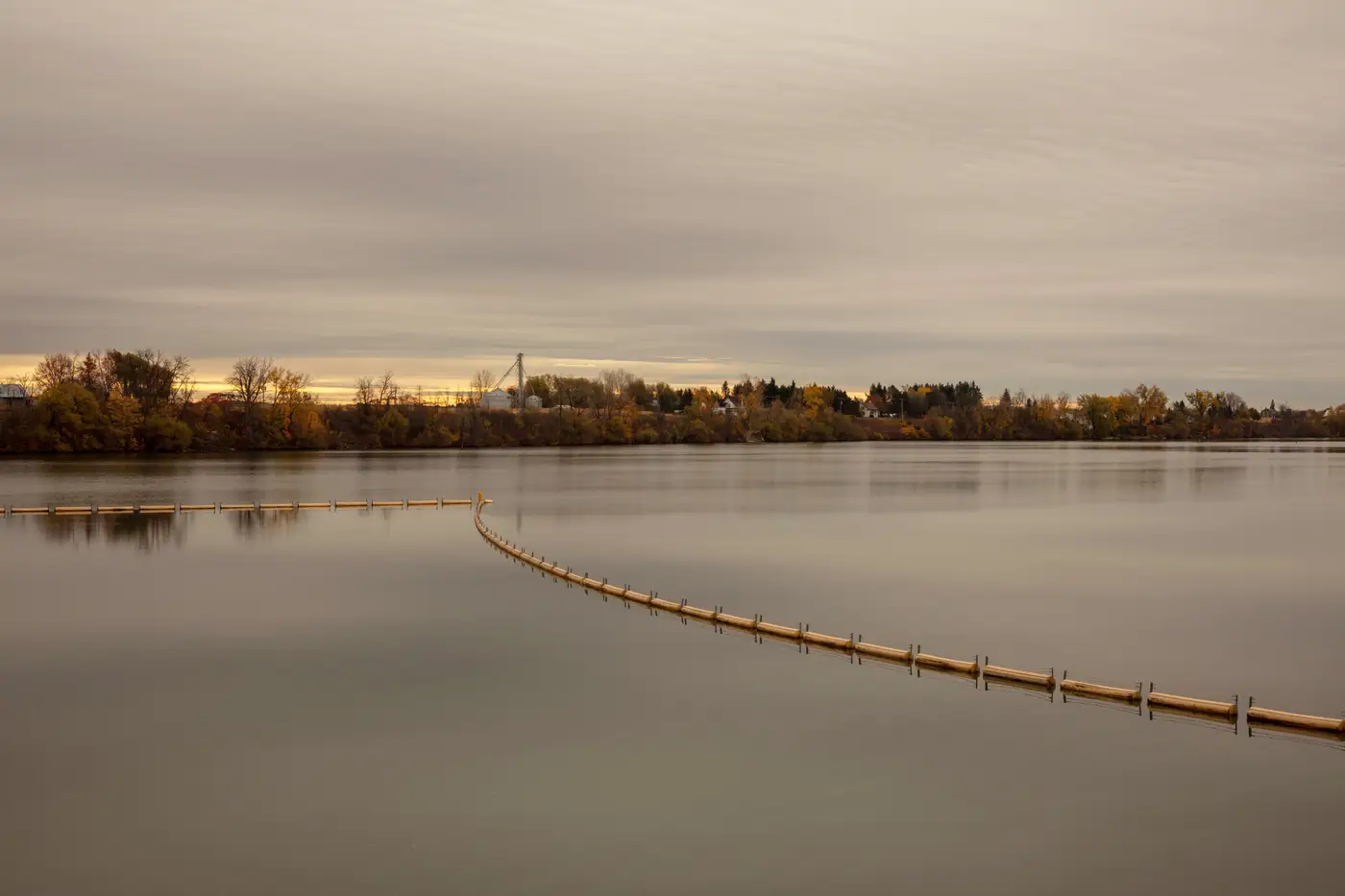
Get the angle wrong and a boom that looked fine on the chart turns into a debris fountain the first time the river comes up. Here's the math crews use to set a boom-to-bank angle, and the part the math can't give you.
Why angle matters more than boom length
A boom doesn't stop water, it redirects floating material along its face toward a collection point. The current hits the boom skirt at some angle, and only the component of that current running perpendicular to the boom face does the work of pushing debris sideways. Run the boom straight across the channel, square to the flow, and the full force of the current slams into the skirt. Past a certain speed the boom submerges, debris rides the plunging flow under the skirt, and you lose everything you were trying to catch. That failure mode has a name in the trade: splash-over, and sometimes just plain entrainment when it goes under rather than over.
Angle the boom instead, and the current component hitting the face perpendicular drops, while the component running along the boom's length carries debris toward the bank or the apex where your crew is staged.
The formula
The standard relationship, the one used across oil-spill and litter-boom deployment guides alike, is:
sin(θ) = Vc / V
Where θ is the angle between the boom and the current direction (not the angle to the bank, that's the complement), Vc is the critical velocity your boom's skirt and freeboard are rated to hold before splash-over, and V is the measured or estimated current speed at the site.
Manufacturers generally rate permeable litter booms somewhere in the 0.7 to 1 knot critical velocity range, though that number moves with skirt depth, freeboard height, and how much the boom has fouled with debris and biofilm since last serviced. Check the spec sheet for the actual boom you're running, not a figure from a different product line.
Plug in your numbers and solve for θ. A current running at 2 knots against a boom rated for 0.7 knots critical velocity gives sin(θ) = 0.35, so θ sits around 20 degrees off the current direction. That's a tight angle, closer to parallel with the flow than most people expect, and it's why booms on fast reaches end up looking almost like they're running downstream rather than across it.
Convert that to a boom-to-bank figure by subtracting from 90: in this example, roughly 70 degrees off the bank. Steeper water means a tighter angle to the current and a shallower one to the bank.
What the angle calculation doesn't tell you
Get the trigonometry right and you've solved for whether the boom holds at all. You haven't solved for whether it's catching anything. A boom angled correctly across a stretch with no accumulating debris just deflects clean water. The current speed at your crossing section sets the geometry, but it says nothing about where along the bank, bend, or confluence the floating plastic is actually piling up that month.
That's a separate question from the deflection math, and it's the one that moves crews around after every storm, chasing last month's drift line instead of this month's. A monthly read of where debris is gathering along your reach, flagged from satellite imagery rather than the last site visit, lets you pick the crossing section first and then run the angle calculation for that specific spot, instead of re-angling a boom that was never sited where the plastic collects. You can see how that read works at Plastic Accumulation.
Run the angle math for your current speed and boom rating before every deployment, current speeds shift with season and rainfall, and a boom angled for July low flow won't hold through a spring freshet. If you're still picking the crossing section by memory of where the last cleanup happened, get on the early access list and let a monthly accumulation read do that part first.